Lessons in your path0 of 8 complete
Progress settings
Saved only in this browser.
This lesson is outside your selected path. You can still explore it, or .
Visual explainerExpand diagramCollapse diagram +
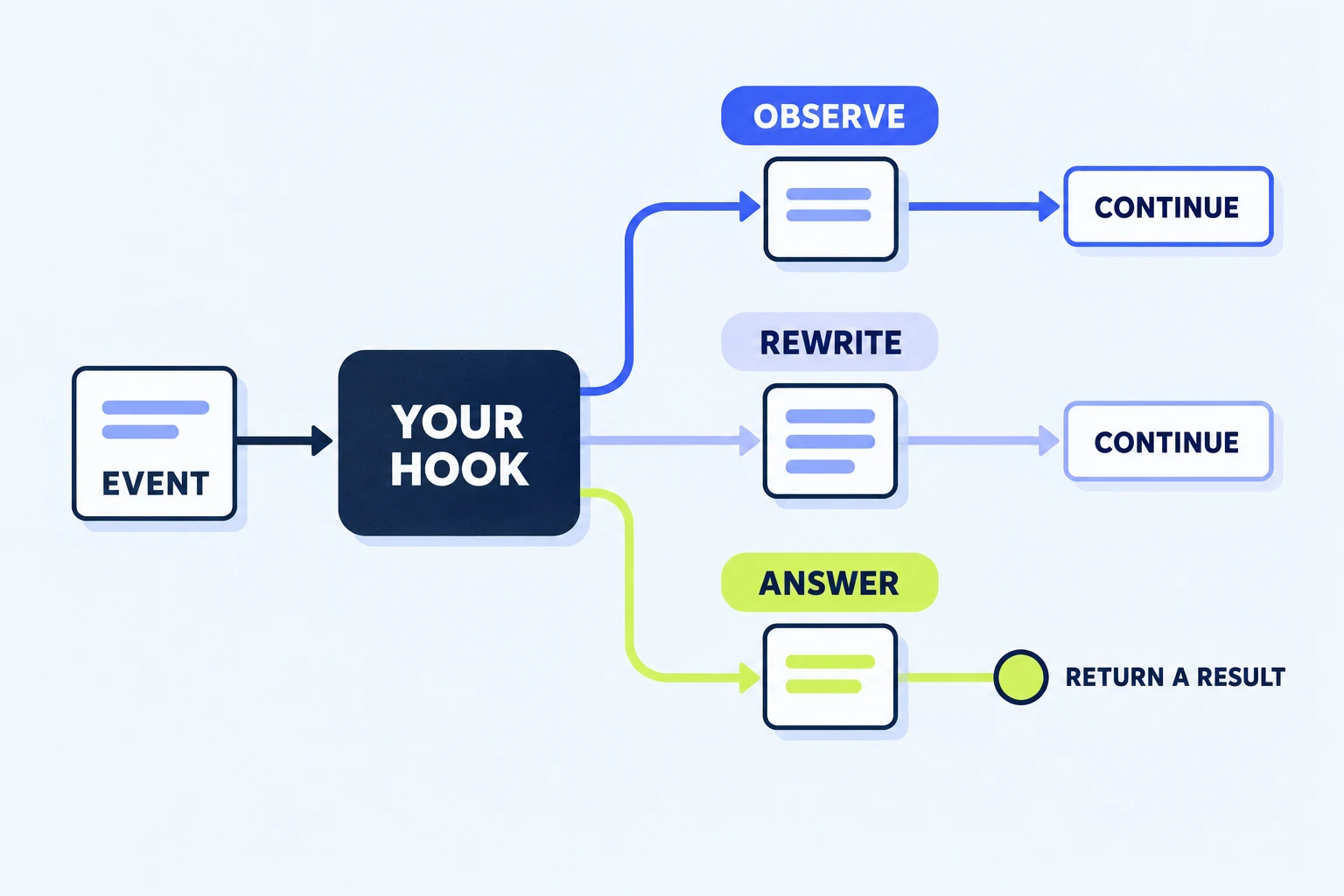 Observe and rewrite continue the event chain. Answer handles the event locally.
ObserveForward the same event.
RewriteForward a changed copy.
AnswerReturn a result here.
BROWSER SIMULATION · NO CLAUDE CONNECTION
Event→Our hook→Next handler
Observe the call and pass the same event to the next handler.
TRACEReady. Nothing has run yet.
What are $, e, and next?
$ · the host API- Register a command, fill a draft, save a value, or ask the UI to redraw.
e · the event- The data for this action. Treat it as immutable; create a copy to change it.
next(e) · continue the chain- Pass the event to downstream mods and the engine. Return your own result to handle it instead.
A minimal observer JavaScript
on('tool.call', async ($, e, next) => {
  calls += 1;
  $.ui.invalidate('ui.render');
  return next(e);
});
Counting is ordinary JavaScript. Redrawing is a host API call. Forwarding preserves the tool’s normal behavior.
YOUR TURN
Try it, then explain it.
- Run Observe and inspect the trace.
- Run Rewrite with the prefix, then with an ordinary prompt.
- Run Answer with 2 and 4 portions. Compare a result with a denial.
QUICK CHECK · OPTIONALWhat makes the demo tool handler answer locally?
Finish at your own pace.The next button saves completion and opens the next lesson.
